Why Cap Embroidery Is Technically Demanding
Embroidery machines are usually described by their flat-field performance, but a cap behaves nothing like a flat hoop. Three problems appear as soon as a design moves onto a cap.
- Curved surface. The front panel of a cap curves in two directions. A flat hoop holds fabric in one plane; a cap frame must hold the crown so the needle follows the curve without the fabric lifting or puckering.
- Structured crowns. Many caps are stiffened with buckram or fused backing. The embroidery area is small and the fabric does not stretch, so poor hooping shows immediately as distortion around the design.
- Centred designs. Cap designs are almost always centred on the front panel and aligned to the seam and brim. A fraction of a millimetre of misalignment is visible to the customer, so the frame must locate the cap repeatably.
These constraints are why cap work is done on a machine with a purpose-built cap system rather than on a flat table alone.
The 270-Degree Wide Angle Cap System
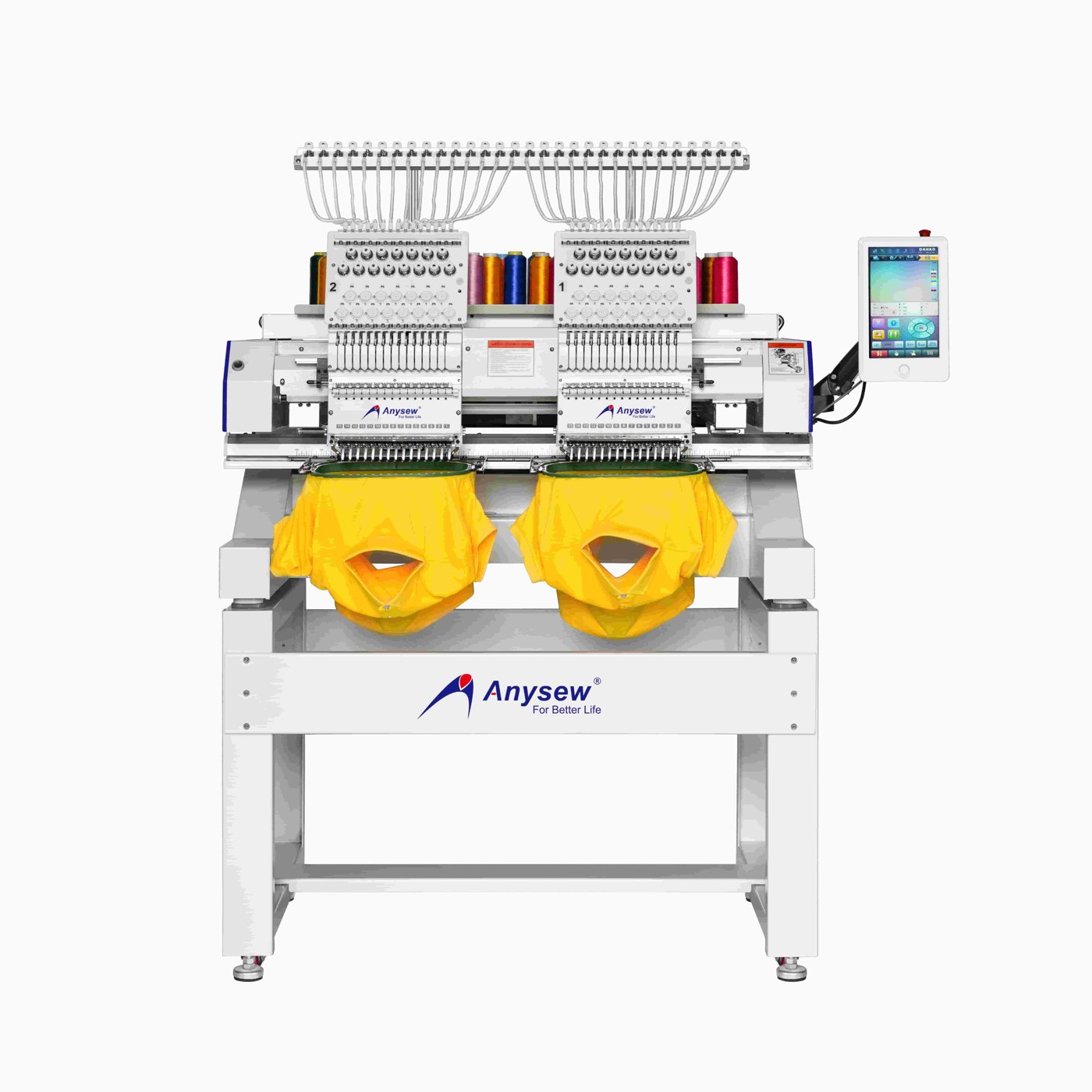
The AS-BC1202 is equipped with a 270-degree wide angle cap system. The wide angle refers to the arc through which the cap frame can be driven, which allows the embroidery field to follow the curve of the crown rather than treating the cap as a flat panel. In practice this means designs can be placed further around the front panel and onto the side panels without the stitch quality falling away at the edges.
The headline facts for the AS-BC1202 are:
| Specification | Detail |
|---|---|
| Heads | 2 |
| Needles | 12 or 15 |
| Maximum embroidery area | 450 x 400 mm (flat field) |
| Maximum speed | 1,200 rpm |
The 450 x 400 mm figure is the machine's published maximum embroidery area on the flat field. The usable sewing area on a cap frame is smaller — it is set by the frame and the cap's front panel — and is confirmed for your cap designs on quotation.
Two heads suit a cap-focused business because caps are usually ordered in small runs with several designs; the second head runs the same design in parallel, so two caps progress together under one operator — extra capacity for short runs, though output still depends on stitch count and changeovers rather than doubling automatically. The 12 or 15 needle choice is a colour-count decision: 15 needles reduce manual thread changes on multi-colour logos, while 12 needles cover most corporate and team designs.
Cap Frames and Hoop Sizes
A cap frame is a separate fixture from a flat hoop, and the range of frames supplied matters as much as the machine. Multiple hoop sizes are supplied per the supplier listing, which allows different cap styles and design sizes to be handled without improvising. When specifying, confirm with the supplier which cap frames and hoop sizes are included, because a machine that only ships with one frame size limits the work you can accept.
Switching Between Caps, Flat Fabrics and Finished Garments
A cap-focused business rarely does only caps. The same machine should move between cap frames, flat hoops for panels and bags, and tubular hoops for finished garments such as polo shirts and jackets. The practical test is changeover time and repeatability: how long it takes to remove a cap frame, fit a flat hoop, and return to cap work without losing registration. Ask for this to be demonstrated, and confirm the available hoop and frame set on quotation.
What to Check Before Buying
Use this checklist when comparing cap embroidery machines. It applies to any machine, not only the AS-BC1202.
- Design size. Measure your largest and smallest cap designs. Confirm the cap frame can hold the design with margin for the curve, not just the flat measurement.
- Cap types. Structured six-panel caps, unstructured caps, five-panels, and flat-brim styles all hoop differently. List the types you will actually run and confirm frame compatibility.
- Daily volume. Estimate caps per day and per design. Two heads at 1,200 rpm suits short runs; high-volume single-design work may justify a different configuration.
- File formats. Confirm the machine accepts the formats your customers and designers supply, and that your digitising software outputs them.
- Frame and hoop set. Confirm exactly which cap frames and hoop sizes are included, and the cost of additional frames.
- Changeover. Ask for a demonstration of switching between cap and flat work.
- Service and spares. Confirm spare parts supply, installation and debugging, and after-sales maintenance support.
- Commercial terms. MOQ and lead time are confirmed on quotation. Certificates available upon request.
For a deeper walkthrough of these points, read Cap Embroidery Machines: What to Check Before Buying.
Where the AS-BC1202 Fits
The AS-BC1202 Double Head Embroidery Machine is the cap-capable model in the range, with the 270-degree wide angle cap system, 2 heads, 12 or 15 needles, a maximum embroidery area of 450 x 400 mm on the flat field and 1,200 rpm. Full details are on the AS-BC1202 Double Head Embroidery Machine page. For buyers who need a different configuration, specifications are confirmed on quotation rather than assumed from a catalogue.
Buyer Checklist Summary
- Largest and smallest cap design measured
- Cap types listed and frame compatibility confirmed
- Daily and per-design volume estimated
- File formats checked against customer supply
- Included cap frames and hoop sizes confirmed
- Changeover between cap and flat work demonstrated
- Spare parts, installation and maintenance support confirmed
- MOQ and lead time confirmed on quotation
To discuss a cap embroidery requirement, request a quotation through the contact page and include your design sizes, cap types and expected volume.