Start with the Cutting Method, Not the Price
Three cutting methods dominate garment production, and each suits a different mix of ply height, curve work and precision requirements.
- Straight knife cutting uses a vertical reciprocating blade and is the workhorse for high ply stacks. It handles long, relatively straight runs and gentle curves well, and it is the usual choice where daily volume is high and the marker is laid in multiple plies.
- Round knife cutting uses a rotating circular blade. It is fast and manoeuvrable on low to medium plies and is well suited to curved pattern pieces, but it loses accuracy as stack height increases.
- Band knife cutting uses a continuous loop blade on a fixed table. It is the precision option for small parts, tight curves and re-cutting, and it is often used after a straight knife has broken down a large lay.
As a rule of thumb: high plies and long runs point to straight knife; low plies and curved work point to round knife; small, precise parts point to band knife. Many workshops use more than one method, which is why the selection question is really about your product mix rather than a single "best" machine. Our comparison article, Straight Knife vs Round Knife vs Band Knife Cutters, sets out the trade-offs in more detail.
Electric Fabric Cutter Options
Within the electric cutter family, buyers typically weigh three things: how the machine is driven, how the blade is maintained, and how the base and handle suit the operator's working position.
Servo-driven models give steadier torque under load, which matters when the blade is working through a tall stack. Automatic sharpening reduces downtime and keeps cut edges consistent across a long shift. Base plate size and handle configuration affect how easily the operator follows a marker line, and cutting height range determines the maximum ply count the machine can take. For buyers comparing options, the practical approach is to shortlist two or three configurations that match your ply heights, then confirm the exact electrical and blade details on quotation.
Where the CZD-708D Fits
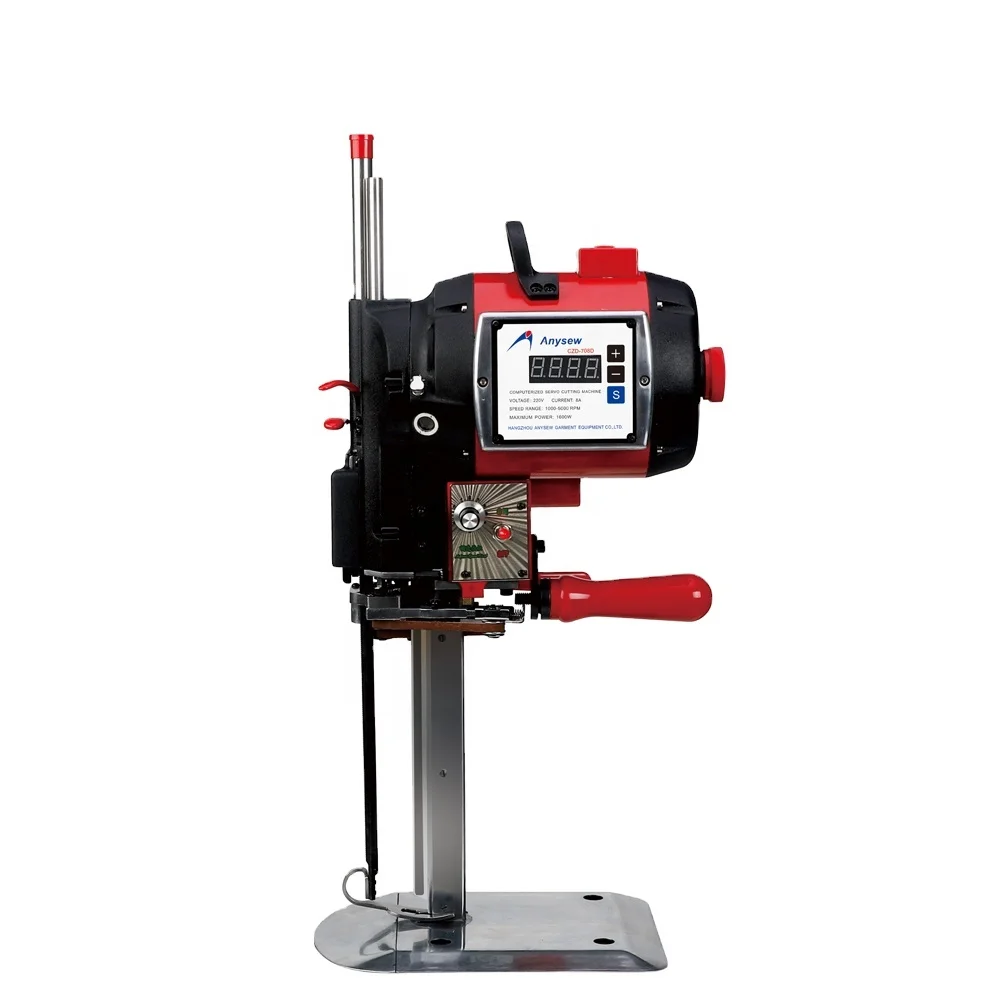
The reference straight knife model in our range is the CZD-708D Straight Knife Cutting Machine, a 1600 W servo-driven machine with automatic sharpening and a cutting height range of 110, 160, 210, 260 and 285 mm depending on configuration. It is intended for materials from cotton and silk through to leather, which makes it a general-purpose straight knife rather than a specialist leather cutter. If your production is built around multi-ply lays across the listed material range (cotton, woolens, linen, silk, chemical fiber and leather), this is the model to examine first. If your work is dominated by small precision parts or very low plies, review the round knife and band knife options before settling.
Specification Inputs to Prepare
Before you request a quotation, gather the following. These inputs let a supplier match a machine to your line rather than guess.
- Fabric types: the full list of materials you cut, including weight ranges and any coated, laminated or leather items.
- Ply height: the maximum and typical number of plies in your lays, not just the average.
- Daily volume: metres or garments cut per shift, plus how many shifts per day.
- Curve complexity: the share of pattern pieces with tight curves or small parts.
- Table and space: cutting table dimensions, available floor space and how the machine will be moved or stored.
- Power supply: the voltage and phase available at your site.
- Operator skill: whether the machine will be used by experienced cutters or by staff who need simpler controls.
Specifications, including electrical configuration and blade details, are confirmed on quotation.
Buyer Checklist
Use this checklist to compare suppliers on equal terms.
- Cutting method matches your ply height and curve work.
- Cutting height range covers your tallest lay with margin.
- Drive type and sharpening method suit your shift length.
- Machine footprint fits your cutting table and storage.
- Power supply matches your site.
- Spare blades and wear parts are available as a supply item.
- Installation, debugging and after-sales support are clearly described.
- Certificates available upon request.
- Commercial terms, including MOQ and lead time, confirmed on quotation.
For a broader view of the category, including the other cutting and finishing equipment we supply, see Cloth Cutting Machines.
Request a Quotation
Send us your fabric list, ply heights, daily volume and site power details through the contact page, and we will confirm the suitable configuration and commercial terms on quotation. Our one-stop service covers product customization, quality inspection, installation and debugging, after-sales maintenance, spare parts supply, and logistics and transportation, so the machine and its ongoing consumables can be handled together.